
Watercol™ 1910 Capillary GC Columns for Water Analysis

Introduction
Watercol™ 1910 capillary GC columns represent a significant advancement in gas chromatography, enabling direct qualitative and quantitative analysis of water in diverse matrices without the need for specialized testing procedures. These columns feature highly polar ionic liquid stationary phases specifically designed for water analysis applications.
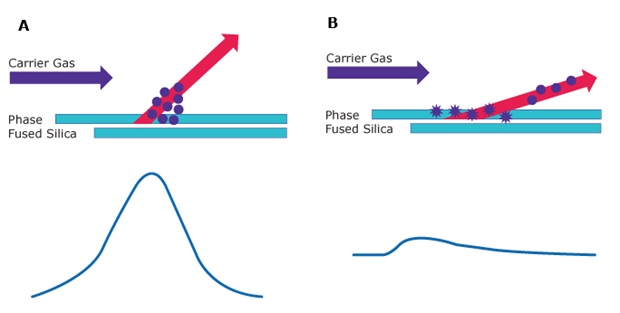
Figure 1.Interaction with water with stationary phases and carrier gas transfer, A) ionic liquid phase, Watercol™ 1910, B) non-ionic liquid stationary phases. As seen with the Watercol™ 1910, there is efficient transfer of water molecules from the stationary phase into the carrier gas leading to a sharper water peak in analysis. Whereas with non-ionic liquid, the interaction with the stationary phase prevents efficient consolidated transfer to the carrier gas leading to a decrease signal response and the broadening/tailing during analysis.
Key Benefits
- Simultaneous analysis: Enables measurement of trace levels of water and organic compounds using a single GC method
- Enhanced laboratory efficiency: Integrates water analysis seamlessly into routine GC workflows
- High analytical confidence: Ensures reliable and reproducible results across a wide concentration range
- Direct aqueous injection: Supports injection of aqueous samples on highly polar columns without the need for solvent exchange
Technical Performance
Watercol™ 1910 columns deliver exceptional chromatographic performance for water analysis:
- Superior peak shape: For water and other polar compounds
- Excellent stability: Under aqueous conditions
- Enhanced selectivity: Enables accurate water determination
- Wide dynamic range: Supports analysis across varying water concentrations
Watercol™ 1910 capillary GC columns incorporate an innovative highly polar ionic liquid stationary phase designed to deliver sharp peak shapes for water while maintaining stability under aqueous conditions, in contrast to conventional highly polar phases such as cyanopropyl. Narrow peak widths and optimal peak heights are also achieved for a wide range of small polar analytes.
These columns are particularly suitable for applications where
- Water is the analyte
- Water is used as the injection solvent
Applications for Water Detection
- Liquid petroleum products (e.g. LPG, gasoline)
- Alcohols
- Ethanol
- Solvents
- Ibuprofen
- Additional matrices (see selected references)
See the brochure for application details.
Sub-ppm Water Detection
The Watercol™ 1910 column, when coupled with appropriate detection systems, enables reliable and reproducible measurement of water across a wide concentration range, from approximately 0.5 ppm to >99% water, in diverse matrices.
For sub-ppm level detection, the column can be used with the Shimadzu Nexis GC-2030 Trace Moisture Analysis GC/BID system. For higher concentration ranges (approximately 100 ppm to >99%), detection can be performed using a thermal conductivity detector (TCD). Under these conditions, suitable water retention, separation, and peak shape are obtained.
Applications utilizing the Trace Moisture Analysis system in combination with the Watercol™ 1910 capillary column include:
- Analysis of moisture in nitrogen
- Trace moisture in siloxane matrices
- Water in liquefied petroleum gas
- Trace water in oil matrices
- As an alternative to the Karl Fischer titration technique
Explore a range of chromatograms demonstrating representative separations are available for matrices including gasoline, solvents, pharmaceuticals, alcohols, and beverages.
Assess the use of this column for water analysis to support consistent performance, improved workflow efficiency, and reduced analysis time and operational costs.
Related Products
Selected Peer Reviewed Articles
To continue reading please sign in or create an account.
Don't Have An Account?