


Quality Level
grade
anhydrous, battery grade
assay
99.999% trace metals basis
form
powder
reaction suitability
core: lithium
greener alternative product characteristics
Design for Energy Efficiency
Learn more about the Principles of Green Chemistry.
sustainability
Greener Alternative Product
impurities
≤15 ppm (trace metals analysis)
mp
264 °C (lit.)
solubility
soluble (H2O: highly soluble(lit.); alcohols: soluble(lit.); acetone: soluble(lit.))
application(s)
battery precursors
catalysts
material synthesis precursor
SMILES string
[Li+].[O-][N+]([O-])=O
InChI
1S/Li.NO3/c;2-1(3)4/q+1;-1
InChI key
IIPYXGDZVMZOAP-UHFFFAOYSA-N
General description
Lithium nitrate is a white, crystalline salt that is soluble in water, ethanol, methanol, pyridine, ammonia, and acetone. Importantly, it is also highly soluble up to 5 wt% in ether-based solvents such as dimethoxyethane (DME) and 1,3-dioxolane (DOL), but only soluble up to 1 wt% in carbonate-based solvents like ethylene carbonate (EC) and diethtyl carbonate (DEC).
Lithium nitrate is produced by reacting nitric acid and lithium carbonate, which evolves carbon dioxide and water. The resulting material is purified and dried.
Lithium nitrate is produced by reacting nitric acid and lithium carbonate, which evolves carbon dioxide and water. The resulting material is purified and dried.
We are committed to bringing you Greener Alternative Products, which adhere to one or more of The 12 Principles of Greener Chemistry. This product has been enhanced for energy efficiency. Click here for more information.
Application
Researchers and manufacturers use lithium nitrate in the synthesis of many lithium compounds. Our 99.999% lithium nitrate is well-suited as a reagent for solid-state syntheses of lithium metal oxides, especially where purity is of high importance, for example, when making products whose fundamental properties are under investigation.
Our 99.999% lithium nitrate is also well-suited for use as an additive to electrolytes in lithium-sulfur batteries and lithium metal batteries. Lithium nitrate can passivate the surface of lithium metal and suppress the redox shuttle of the dissolved lithium polysulfides on the lithium anode. In one study, the addition of 0.3 M LiNO3 nearly doubled the gravimetric capacity of lithium-sulfide batteries. Another study found that the dissolution of 1 to 5 wt% LiNO3 to the electrolyte suppressed growth of lithium dendrites and extended cycle lifetimes. Similarly beneficial effects of lithium nitrate as an additive have been observed with Li2S cathodes, carbon nanofiber-encapsulated sulfur cathodes, cobalt sulfide (Co3S4) cathodes, and polyacrylonitrile-sulfur composite cathodes. Even lithium metal anodes with LiNi0.8Co0.15Al0.05O2 (NCA) cathodes with LiNO3 added to the electrolyte showed higher coulombic efficiencies and suppressed dendrite formation compared to the electrolyte without LiNO3.
Our 99.999% lithium nitrate is also well-suited for use as an additive to electrolytes in lithium-sulfur batteries and lithium metal batteries. Lithium nitrate can passivate the surface of lithium metal and suppress the redox shuttle of the dissolved lithium polysulfides on the lithium anode. In one study, the addition of 0.3 M LiNO3 nearly doubled the gravimetric capacity of lithium-sulfide batteries. Another study found that the dissolution of 1 to 5 wt% LiNO3 to the electrolyte suppressed growth of lithium dendrites and extended cycle lifetimes. Similarly beneficial effects of lithium nitrate as an additive have been observed with Li2S cathodes, carbon nanofiber-encapsulated sulfur cathodes, cobalt sulfide (Co3S4) cathodes, and polyacrylonitrile-sulfur composite cathodes. Even lithium metal anodes with LiNi0.8Co0.15Al0.05O2 (NCA) cathodes with LiNO3 added to the electrolyte showed higher coulombic efficiencies and suppressed dendrite formation compared to the electrolyte without LiNO3.
Still not finding the right product?
Explore all of our products under 硝酸锂
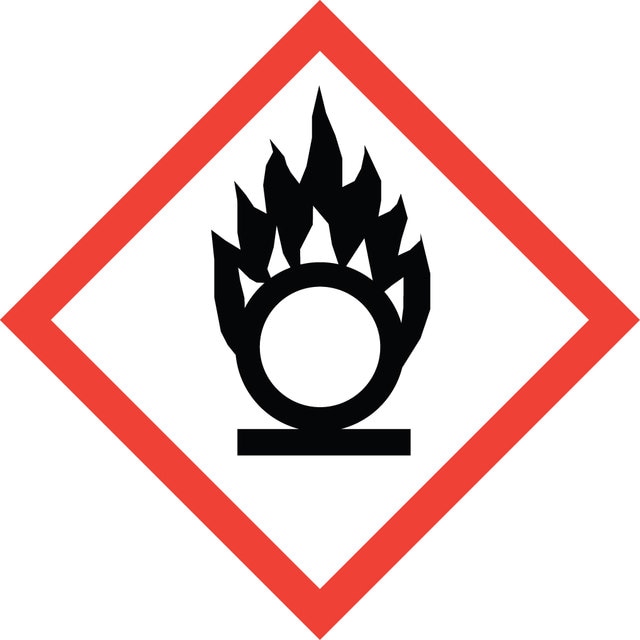

signalword
Warning
hcodes
Hazard Classifications
Acute Tox. 4 Oral - Eye Irrit. 2 - Ox. Sol. 3
存储类别
5.1B - Oxidizing hazardous materials
wgk
WGK 1
flash_point_f
Not applicable
flash_point_c
Not applicable
法规信息
危险化学品
此项目有
Chong Yan et al.
Angewandte Chemie (International ed. in English), 57(43), 14055-14059 (2018-08-11)
The lithium metal anode is regarded as a promising candidate in next-generation energy storage devices. Lithium nitrate (LiNO3 ) is widely applied as an effective additive in ether electrolyte to increase the interfacial stability in batteries containing lithium metal anodes.
On the Surface Chemical Aspects of Very High Energy Density, Rechargeable Li?Sulfur Batteries.
Aurbach D, et al.
Journal of the Electrochemical Society, 156, A694-A694 (2009)
Tao Chen et al.
Journal of the American Chemical Society, 139(36), 12710-12715 (2017-08-25)
Lithium-sulfur batteries (Li-S) have attracted soaring attention due to the particularly high energy density for advanced energy storage system. However, the practical application of Li-S batteries still faces multiple challenges, including the shuttle effect of intermediate polysulfides, the low conductivity
全球贸易项目编号
| 货号 | GTIN |
|---|---|
| 930938-10G | 04065268021101 |
| 930938-50G | 04065268021118 |