Skip to Content
Merck
CN

22550

Quinaldine

≥95.0% (GC)

Synonym(s):

2-Methylquinoline

Sign In to View Organizational & Contract Pricing.

Select a Size

Change View

About This Item

Empirical Formula (Hill Notation):
C10H9N
CAS Number:
Molecular Weight:
143.19
UNSPSC Code:
12352100
NACRES:
NA.22
PubChem Substance ID:
EC Number:
202-085-1
Beilstein/REAXYS Number:
110309
MDL number:
Assay:
≥95.0% (GC)
Form:
liquid
Technical Service
Need help? Our team of experienced scientists is here for you.
Let Us Assist


assay

≥95.0% (GC)

form

liquid

refractive index

n20/D 1.612 (lit.)

bp

105-107 °C/10 mmHg (lit.), 248 °C (lit.)

mp

−9-−3 °C (lit.)

solubility

chloroform: soluble(lit.), diethyl ether: soluble(lit.), water: insoluble(lit.)

density

1.058 g/mL at 25 °C (lit.)

SMILES string

Cc1ccc2ccccc2n1

InChI

1S/C10H9N/c1-8-6-7-9-4-2-3-5-10(9)11-8/h2-7H,1H3

InChI key

SMUQFGGVLNAIOZ-UHFFFAOYSA-N

Gene Information

human ... CYP1A2(1544)

General description

Quinaldine is an organic compound prepared by the Skraup method from crotonaldehyde and aniline with sulfuric acid in the presence of a dehydrogenating agent. Several dyes, including trimethinecyanine dye, pinacyanol dye, vinylogous dye, quinophthalone dye and the quinaldine red are synthesized using quinaldine. Additionally, it is employed in the production of pharmaceuticals, pH indicators, food colorants, oil-soluble dyes, and other chemical compounds.

Application

Quinaldine can be used:
  • In the preparation of squaraine dyes (quinaldine-based squaraine dyes) which is biologically significant and can be used as an metal ion sensor.
  • To prepare the pH sensitive colorimetric chemo sensors.

Features and Benefits

2-methylquinoline is biodegradable.

Disclaimer

may discolor to brown upon storage


Still not finding the right product?

Explore all of our products under Quinaldine

pictograms

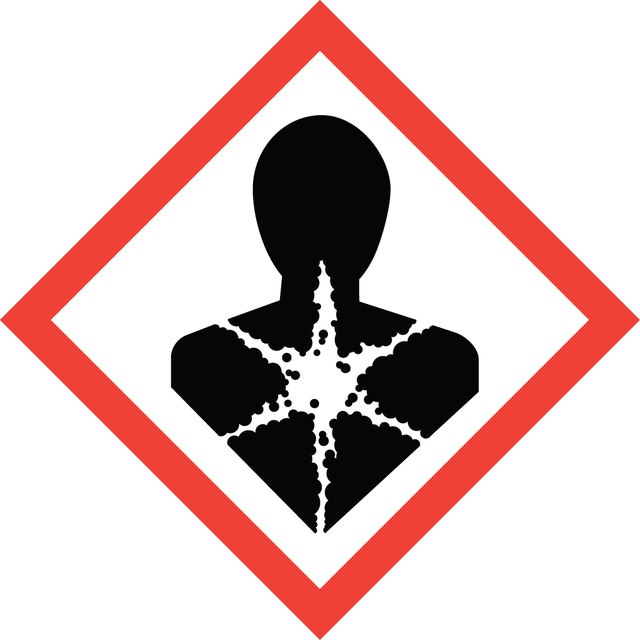
Health hazardExclamation mark

signalword

Warning

Hazard Classifications

Acute Tox. 4 Dermal - Acute Tox. 4 Oral - Aquatic Chronic 3 - Eye Irrit. 2 - Muta. 2 - Skin Irrit. 2

Storage Class

10 - Combustible liquids

wgk

WGK 3

flash_point_f

174.2 °F - closed cup

flash_point_c

79 °C - closed cup

ppe

Eyeshields, Faceshields, Gloves, type ABEK (EN14387) respirator filter

Regulatory Information

危险化学品

This item has


Choose from one of the most recent versions:

Certificates of Analysis (COA)

Lot/Batch Number

Don't see the Right Version?

If you require a particular version, you can look up a specific certificate by the Lot or Batch number.

Already Own This Product?

Find documentation for the products that you have recently purchased in the Document Library.

Visit the Document Library


H Cope et al.
European journal of medicinal chemistry, 41(10), 1124-1143 (2006-06-20)
Transmissible spongiform encephalopathies (TSEs) are thought to arise from aggregation of a protease resistant protein denoted PrP(Sc), which is a misfolded isoform of the normal cellular prion protein PrP(C). Using virtual high-throughput screening we have selected structures analogous to acridine
J X Zhang et al.
Chemical senses, 30(9), 727-737 (2005-10-14)
Quantitative stir bar sorptive extraction methods, both in the aqueous and headspace modes, followed by thermal desorption gas chromatography-mass spectrometry were used to investigate individual variations in the volatile components of male and female ferret (Mustela furo) urine. The urinary
Daniela Pucci et al.
Chemical communications (Cambridge, England), (19)(19), 2254-2256 (2008-05-09)
The synthesis of the first gallium(III)-based liquid crystal has been achieved grafting around the metal centre two chelating 2-methylquinolin-8-olate anions and one monodentate 3,4,5-tris(hexadecyloxy)benzoyloxy ligand, allowing the resulting complex to be a soft luminescent material with the typical high quantum


Global Trade Item Number

SKUGTIN
22550-1L-F04061838252579
22550-250ML-F04061838779496