Skip to Content
Merck
CN

329541

Dicumyl peroxide

98%

Synonym(s):

Bis(1-methyl-1-phenylethyl) peroxide, Bis(α,α-dimethylbenzyl) peroxide

Sign In to View Organizational & Contract Pricing.

Select a Size

Change View

About This Item

Linear Formula:
[C6H5C(CH3)2]2O2
CAS Number:
Molecular Weight:
270.37
UNSPSC Code:
12162002
NACRES:
NA.23
PubChem Substance ID:
EC Number:
201-279-3
Beilstein/REAXYS Number:
2056090
MDL number:
Technical Service
Need help? Our team of experienced scientists is here for you.
Let Us Assist


vapor density

9.3 (vs air)

vapor pressure

15.4 mmHg ( 38 °C)

assay

98%

form

solid

reaction suitability

reagent type: oxidant

mp

39-41 °C (lit.)

density

1.56 g/mL at 25 °C (lit.)

storage temp.

2-8°C

SMILES string

CC(C)(OOC(C)(C)c1ccccc1)c2ccccc2

InChI

1S/C18H22O2/c1-17(2,15-11-7-5-8-12-15)19-20-18(3,4)16-13-9-6-10-14-16/h5-14H,1-4H3

InChI key

XMNIXWIUMCBBBL-UHFFFAOYSA-N

Application

Dicumyl peroxide (DCP) is used:
  • in vulcanization of rubber
  • as a crosslinking agent in the synthesis of polylactic acid composite fibers
  • in the preparation of polyethylene composites
  • in the synthesis of polyamide 112/ethylene vinyl acetate copolymer blends.
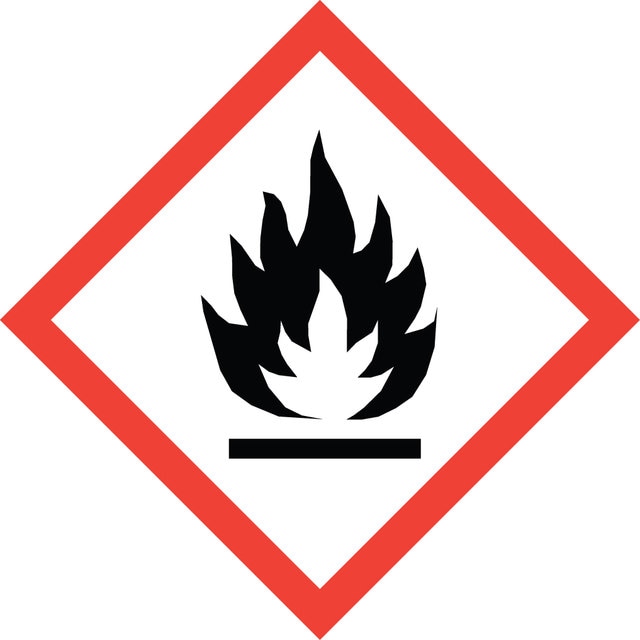

signalword

Danger

Hazard Classifications

Aquatic Chronic 2 - Eye Irrit. 2 - Org. Perox. F - Repr. 1B - Skin Irrit. 2

Storage Class

5.2 - Organic peroxides and self-reacting hazardous materials

wgk

WGK 3

flash_point_f

230.0 °F - closed cup

flash_point_c

110 °C - closed cup

ppe

dust mask type N95 (US), Eyeshields, Gloves, type P3 (EN 143) respirator cartridges

Regulatory Information

危险化学品
易制爆化学品

This item has


Choose from one of the most recent versions:

Certificates of Analysis (COA)

Lot/Batch Number

Don't see the Right Version?

If you require a particular version, you can look up a specific certificate by the Lot or Batch number.

Already Own This Product?

Find documentation for the products that you have recently purchased in the Document Library.

Visit the Document Library


Janghyeon Lee et al.
Sensors (Basel, Switzerland), 19(17) (2019-08-29)
Gas chromatography (GC) is the chemical analysis technique most widely used to separate and identify gas components, and it has been extensively applied in various gas analysis fields such as non-invasive medical diagnoses, indoor air quality monitoring, and outdoor environmental
Dominik Dörr et al.
Polymers, 12(5) (2020-05-18)
For the preparation of polylactide (PLA)-based foams, it is commonly necessary to increase the melt strength of the polymer. Additives such as chain extenders (CE) or peroxides are often used to build up the molecular weight by branching or even
Improvement in mechanical properties of grafted polylactic acid composite fibers via hot melt extrusion
Gunning MA, et al.
Polymer Composites, 35(9), 1792-1797 (2014)


Global Trade Item Number

SKUGTIN
329541-500G04061835571529
329541-100G04061835571512