Skip to Content
Merck
CN

08714

Methyl Red solution

suitable for microbiology

Synonym(s):

Methyl red indicator solution

Sign In to View Organizational & Contract Pricing.

Select a Size

Change View

About This Item

Empirical Formula (Hill Notation):
C15H15N3O2
CAS Number:
Molecular Weight:
269.30
UNSPSC Code:
41171621
NACRES:
NA.85
PubChem Substance ID:
MDL number:
Beilstein/REAXYS Number:
1843037
Technical Service
Need help? Our team of experienced scientists is here for you.
Let Us Assist


Quality Level

agency

according to GB 4789.30-2016, according to ISO 22964:2017

product line

BioChemika

shelf life

limited shelf life, expiry date on the label

composition

dist. water, 200 mL , ethanol 95%, 300 mL , methyl red, 0.1 g

technique(s)

microbe id | metabolite detection: suitable

application(s)

clinical testing
environmental
food and beverages, microbiology

suitability

Enterococcus spp., Escherichia coli, Klebsiella spp., Proteus spp., Pseudomonas spp., Staphylococcus spp., bacteria

SMILES string

CN(C)c1ccc(cc1)\N=N\c2ccccc2C(O)=O

InChI

1S/C15H15N3O2/c1-18(2)12-9-7-11(8-10-12)16-17-14-6-4-3-5-13(14)15(19)20/h3-10H,1-2H3,(H,19,20)/b17-16+

InChI key

CEQFOVLGLXCDCX-WUKNDPDISA-N

General description

Methyl red solution is an azo dye which turns to red when pH is below 4.4 (yellow pH < 6.2, orange pH 4.4-6.2). Some bacteria utilize glucose to form large amounts of acid with the result that the pH value of the medium falls distinct. Other species produce no or less free acid. This difference can be visualized by using methyl red. This test is used to differentiate enteric bacteria.

Application

Methyl red solution is a pH indicator dye recommended for detection of bacteria producing acid from glucose fermentation such as Enterobacteriaceae in various samples.


Still not finding the right product?

Explore all of our products under Methyl Red solution
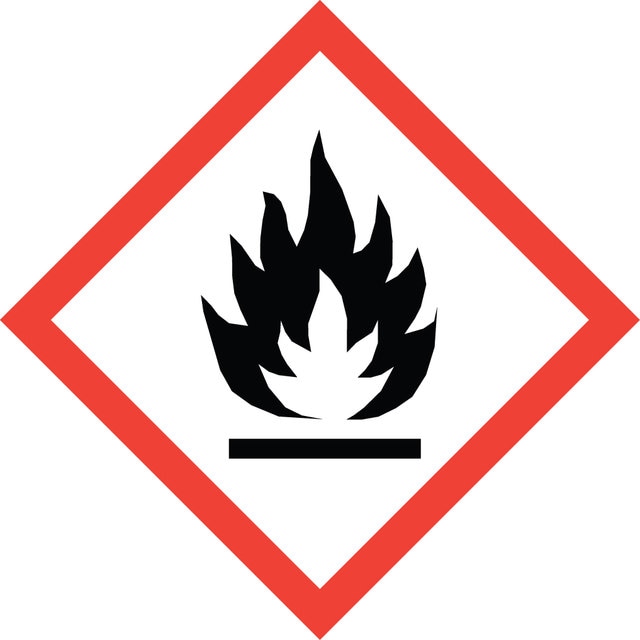

pictograms

FlameExclamation mark

signalword

Danger

hcodes

Hazard Classifications

Eye Irrit. 2 - Flam. Liq. 2

Storage Class

3 - Flammable liquids

wgk

WGK 1

flash_point_f

69.8 °F

flash_point_c

21 °C

ppe

Eyeshields, Faceshields, Gloves, type ABEK (EN14387) respirator filter

Regulatory Information

危险化学品

This item has


Choose from one of the most recent versions:

Certificates of Analysis (COA)

Lot/Batch Number

Don't see the Right Version?

If you require a particular version, you can look up a specific certificate by the Lot or Batch number.

Already Own This Product?

Find documentation for the products that you have recently purchased in the Document Library.

Visit the Document Library


Articles

对于微生物学家而言,最基础的染色方法是由丹麦细菌学家Hans Christian Gram在1884年开发的。

还有许多其他检测方法来指示大肠杆菌的存在。查看这种污染物的常用检测方法和生化反应。

For microbiologists the most fundamental stain was developed in 1884 by the Danish bacteriologist Hans Christian Gram.

View All Articles

Related Content


Oana Alexandru et al.
Journal of neuro-oncology, 102(1), 9-18 (2010-07-17)
A major focus of brain cancer research today is to translate understanding of glioma biology into advances in treatment, by exploring the potential of target therapy. Here we investigated the ability of three compounds belonging to the chemical class of
Yuyi Yang et al.
Bioresource technology, 130, 517-521 (2013-01-17)
Azo dyes are toxic and carcinogenic and are often present in industrial effluents. In this research, azoreductase and glucose 1-dehydrogenase were coupled for both continuous generation of the cofactor NADH and azo dye removal. The results show that 85% maximum
Feng-Yun Wang et al.
Nanoscale, 3(8), 3269-3276 (2011-07-01)
Nanoporous and nonporous three-dimensional silicon nanowire arrays (SiNWAs) prepared with metal-assisted chemical etching method were investigated as photocatalysts in dye photodegradation systematically. In comparison with nonporous SiNWAs, nanoporous SiNWAs have higher surface area, larger pore volume, stronger light absorption and


Global Trade Item Number

SKUGTIN
220868-10G04061836674878
08714-100ML-F04061838652805