Skip to Content
Merck
CN

86040

Sulfamic acid

analytical standard (for acidimetry), ACS reagent

Synonym(s):

Aminosulfonic acid, Sulphamic acid, Amidosulfonic acid

Sign In to View Organizational & Contract Pricing.

Select a Size

Change View

About This Item

Linear Formula:
NH2SO3H
CAS Number:
Molecular Weight:
97.09
NACRES:
NA.25
PubChem Substance ID:
UNSPSC Code:
12161700
EC Number:
226-218-8
MDL number:
Technical Service
Need help? Our team of experienced scientists is here for you.
Let Us Assist


Quality Level

grade

ACS reagent, analytical standard (for acidimetry)

agency

complies with DIN 19266

assay

99.3-100.3% (dried material)

mp

215-225 °C (dec.) (lit.)

anion traces

chloride (Cl-): ≤10 mg/kg, sulfate (SO42-): ≤500 mg/kg

cation traces

Ca: ≤10 mg/kg, Cd: ≤5 mg/kg, Co: ≤5 mg/kg, Cr: ≤5 mg/kg, Cu: ≤5 mg/kg, Fe: ≤5 mg/kg, K: ≤50 mg/kg, Mg: ≤5 mg/kg, Mn: ≤5 mg/kg, Na: ≤50 mg/kg, Ni: ≤10 mg/kg, Pb: ≤5 mg/kg, Zn: ≤5 mg/kg

application(s)

environmental
food and beverages
general analytical
industrial qc
pharmaceutical

format

mixture

SMILES string

NS(O)(=O)=O

InChI

1S/H3NO3S/c1-5(2,3)4/h(H3,1,2,3,4)

InChI key

IIACRCGMVDHOTQ-UHFFFAOYSA-N

General description

Sulfamic acid, a strong inorganic acid, exists in crystalline form. It is stable, non-hygroscopic, odorless, and colorless in dry state, making its commercial packaging and handling convenient.

Application

It can be used as an acidimetric standard for analytical applications.
Sulfamic acid also finds its use as a primary standard in non-aqueous visual, conductometric, and potentiometric titrations.

Features and Benefits

  • Available in a secure glass bottle to ensure its stability for the entire shelf life until opened.
  • High-quality offering accurate titer determinations
  • Accompanied by a detailed certificate of analysis (CoA)


Still not finding the right product?

Explore all of our products under Sulfamic acid
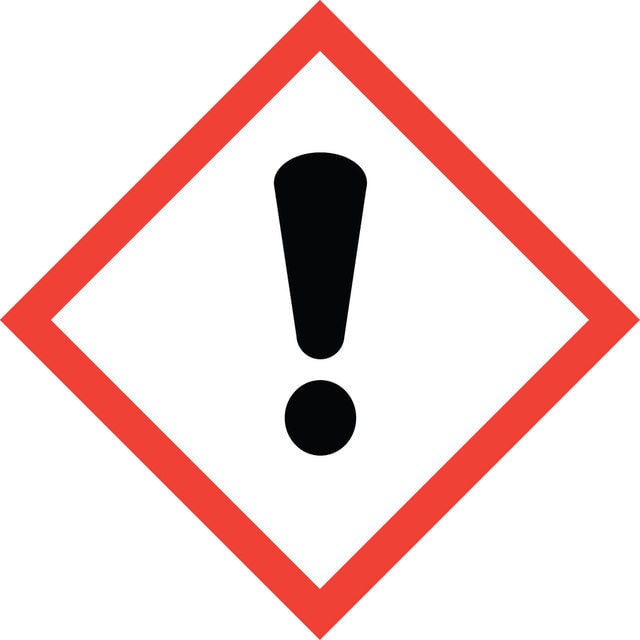

pictograms

Exclamation mark

signalword

Warning

Hazard Classifications

Aquatic Chronic 3 - Eye Irrit. 2 - Skin Irrit. 2

Storage Class

8A - Combustible corrosive hazardous materials

wgk

WGK 1

flash_point_f

Not applicable

flash_point_c

Not applicable

ppe

dust mask type N95 (US), Eyeshields, Faceshields, Gloves

Regulatory Information

危险化学品

This item has


Choose from one of the most recent versions:

Certificates of Analysis (COA)

Lot/Batch Number

Don't see the Right Version?

If you require a particular version, you can look up a specific certificate by the Lot or Batch number.

Already Own This Product?

Find documentation for the products that you have recently purchased in the Document Library.

Visit the Document Library


Jean-Yves Winum et al.
Bioorganic & medicinal chemistry, 21(6), 1419-1426 (2012-12-04)
Targeting tumour associated carbonic anhydrase (CA, EC 4.2.1.1) isoforms IX and XII is now considered as a pertinent approach for the development of new cancer therapeutics against hypoxic tumours. In the last period, with the help of X-ray crystallography, much
Patricia Chávez et al.
The Journal of organic chemistry, 77(4), 1922-1930 (2012-01-31)
An intramolecular diamination of acrylates is reported using sulfamates as nitrogen sources. This reaction proceeds under palladium(II) catalysis with copper bromide as oxidant and gives rise to anti-configured 2,3-diamino carboxylates as bicyclic sulfamate derivatives. An aminobrominated intermediate within the diamination
Na Zhang et al.
The Journal of organic chemistry, 77(14), 5956-5964 (2012-06-21)
The efficiency of arylboron-based nucleophiles, boronic acid, potassium trifluoroborate, neopentylglycolboronate, and pinacol boronate in nickel-catalyzed Suzuki-Miyaura cross-coupling reactions with the two C-O electrophiles, mesylates, and sulfamates was compared. Arylboronic acid is the most reactive and most atom-economic of the four


Global Trade Item Number

SKUGTIN
86040-100G04061833033159
86040-1KG04061826714171
86040-500G04061833439661