
537683

2-Heptanone
99%
Synonym(s):
Methyl pentyl ketone
Sign In to View Organizational & Contract Pricing.
Select a Size
Change View
About This Item
Linear Formula:
CH3(CH2)4COCH3
CAS Number:
Molecular Weight:
114.19
UNSPSC Code:
12352115
NACRES:
NA.21
PubChem Substance ID:
EC Number:
203-767-1
Beilstein/REAXYS Number:
1699063
MDL number:
Assay:
99%
Technique(s):
gas chromatography (GC): suitable
Bp:
149-150 °C (lit.)
Vapor pressure:
2.14 mmHg ( 20 °C)
vapor density
3.94 (vs air)
Quality Level
vapor pressure
2.14 mmHg ( 20 °C)
assay
99%
autoignition temp.
739 °F
expl. lim.
1.11 %, 65 °F, 7.9 %, 121 °F
technique(s)
gas chromatography (GC): suitable
impurities
≤0.05% (water)
refractive index
n20/D 1.408 (lit.)
bp
149-150 °C (lit.)
mp
−35 °C (lit.)
solubility
water: soluble 4.21 g/L at 20 °C
density
0.82 g/mL at 25 °C (lit.)
SMILES string
CCCCCC(C)=O
InChI
1S/C7H14O/c1-3-4-5-6-7(2)8/h3-6H2,1-2H3
InChI key
CATSNJVOTSVZJV-UHFFFAOYSA-N
General description
2-Heptanone, a volatile organic compound, belongs to a class of odorous ketones. The impact of 2-heptanone on the behavioral responses of worker honeybees has been reported. The kinetic of reduction of 2-heptanone by samarium iodide in the presence of hexamethylphosphoramide has been analyzed by gas chromatography (GC).
Application
2-Heptanone has been used as a standard odorous compound in a study to understand the odor responses in basiconic, intermediate and trichoid olfactory receptor neurons of Drosophila melanogaster.
Still not finding the right product?
Explore all of our products under 2-Heptanone
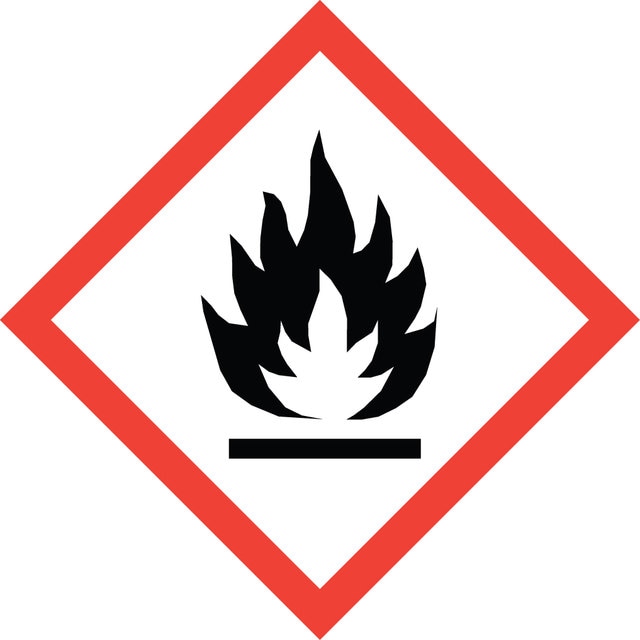

signalword
Warning
hcodes
Hazard Classifications
Acute Tox. 4 Inhalation - Acute Tox. 4 Oral - Flam. Liq. 3 - STOT SE 3
target_organs
Central nervous system
Storage Class
3 - Flammable liquids
wgk
WGK 1
flash_point_f
105.8 °F - closed cup
flash_point_c
41 °C - closed cup
Regulatory Information
危险化学品
This item has
Choose from one of the most recent versions:
Already Own This Product?
Find documentation for the products that you have recently purchased in the Document Library.
Oxidation of 2-heptanone in air by a DBD-type plasma generated within a honeycomb monolith supported Pt-based catalyst.
Ayrault C, et al.
Catalysis Today, 89(1), 75-81 (2004)
Rate study of reduction of 2-heptanone with samarium iodide by gas chromatography.
Fuh MRS, et al.
Talanta, 46(5), 861-866 (1998)
Ontogeny of the fine structure of the mandibular glands of the honeybee (Apis mellifera L.) workers and the pheromonal activity of 2-heptanone.
Vallet A, et al.
Journal of Insect Physiology, 37(11), 789-804 (1991)
Global Trade Item Number
| SKU | GTIN |
|---|---|
| 537683-18L-CS | 04061832565866 |
| 537683-1L | 04061837224850 |
| 537683-100ML | 04061832565859 |